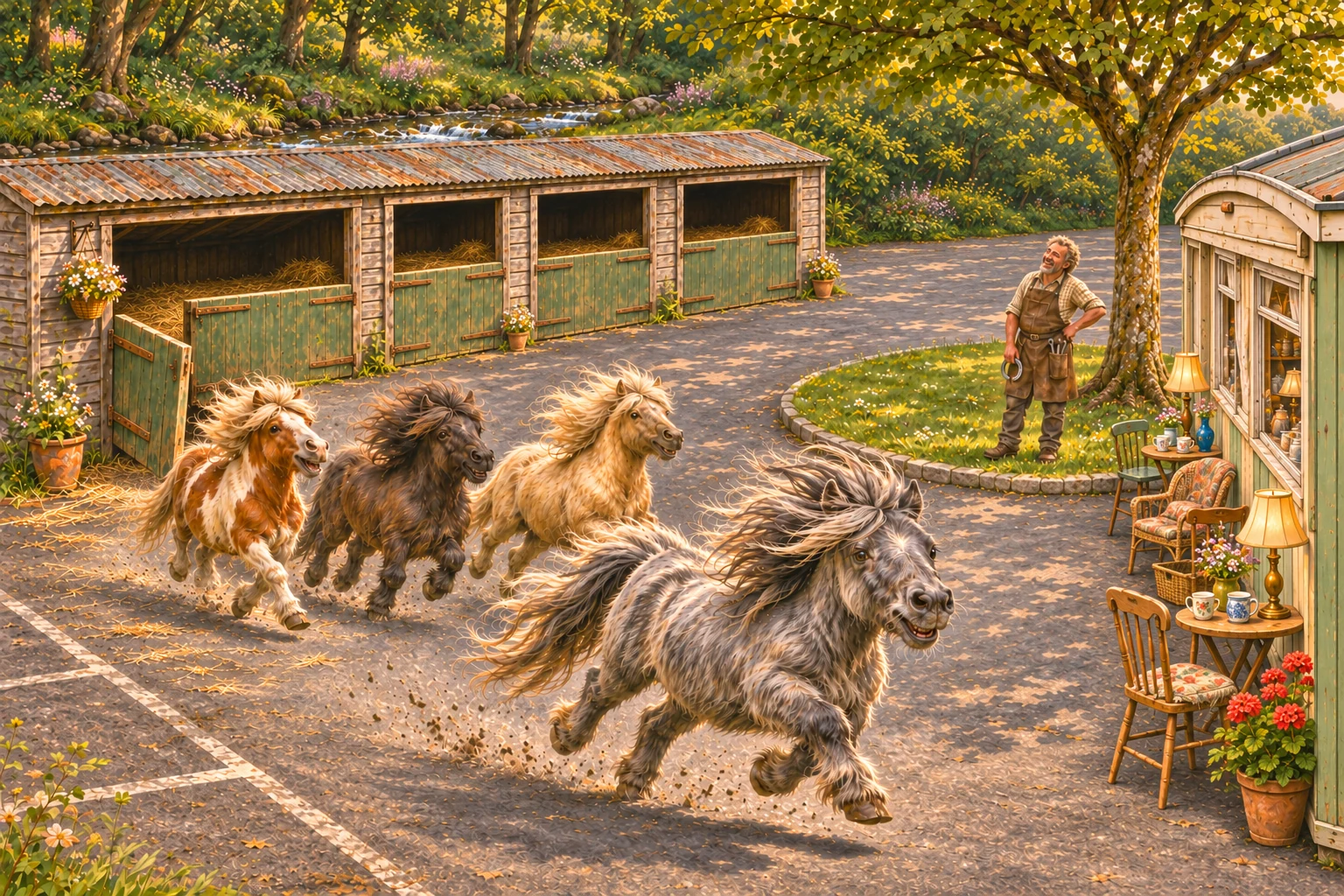
The ponies were indoors that morning, twelve of them across four stables—twelve sets of eyes watching, listening, taking notes. They were normally out in the field by then, and they knew it. They could feel the routine was wrong. They could sense the change in rhythm, the faint tightening of human behaviour that always comes before something you’re going to regret.
Tension builds in a Shetland stable the way it builds in a pub just before someone throws a punch: nothing obvious, just a shift. A hush. A herd collectively deciding that today might be a good day for civil disobedience.
The farrier waited outside on the grass roundabout, tools glinting, sun warm on his shoulders. I stood by the stable door while Lisa slipped inside. She closed it behind her. Good. Calm voice. Good. Soft steps. Good.
Lisa was new. Big-boned, soft-hearted, bespectacled, and constantly trailed by the rustle of a shopping bag full of fizzy drinks, biscuits and chocolate. Billy Bunter in a polo shirt. Residential staff, still finding her way. I’d shown her the technique a dozen times: how to lay a rope just so behind the ears; the angle that gives you leverage over half a ton of stubborn muscle; the quiet approach that keeps panic below ignition point.
There was a rumble. A scuffle. Silence.
Then Lisa called: “Ready! Open up!”
So I cracked the door, careful not to let any opportunists through.
What followed was physics, comedy, and equine strategy, all in a single breath.
A slate-grey pony exploded from the doorway like a missile, a red rope looped lazily around its neck and absolutely nothing attached to the human end. Six feet of rope chased the pony’s shoulder, and then Lisa came with it, head first, as if she’d been launched. She hit the threshold, tripped, and was dragged across the grass straight past the farrier, who may well have thought she was simply over-eager to present her first pony.
Onward into the field they went. Lisa still clung to the rope. I had known these ponies were strong, but to see one maintain full pace while towing a fully-grown woman was almost impressive. Not as impressive, perhaps, as Lisa’s refusal to let go. She managed twenty feet before she rolled onto her back and vanished briefly under a curtain of yesterday’s equine fertiliser.
I was stunned enough that I forgot, for a crucial three seconds, to shut the stable door. Out shot the other three, manes flying, eyes bright with the joy of rebellion. They barreled toward the same field, past the farrier now doubled over, keys and tools abandoned, tears of laughter running freely.
Lisa pushed herself upright, spectacles gone, hair carrying the worst of the field’s souvenirs. She barely had time to orient before two ponies collided with her, scooping her between them like a carnival balloon passed body-to-body without hands. She spun between them, legs flailing, until gravity finally won and she collapsed again into the grass.
By then, I was choking on my own laughter. The farrier had surrendered completely, sitting in his van, red-faced, beyond speech. The appointment was, by universal consent, cancelled.
Lisa emerged apologetic, mud-streaked, mottled with hoofprints and indignity. She didn’t make excuses. She didn’t sulk. She simply nodded, accepted that instructions had been there for a reason, and said she’d do better next time.
The ponies, now in the field, cavorted. Bucking. Rearing. Tossing their heads. If ever a group of animals looked pleased with themselves, it was that herd. I have no proof beyond instinct, but I remain convinced they’d been planning a prison break the whole morning, and Lisa had simply provided the trigger.
Shetlands, after all, are comedians with hooves - and a worrying grasp of physics.
The lesson is simple:
Never mistake small for compliant.
Never underestimate animals who learned to outthink humans to survive.
And always close the stable door - unless you fancy a live-action lesson in gravity.