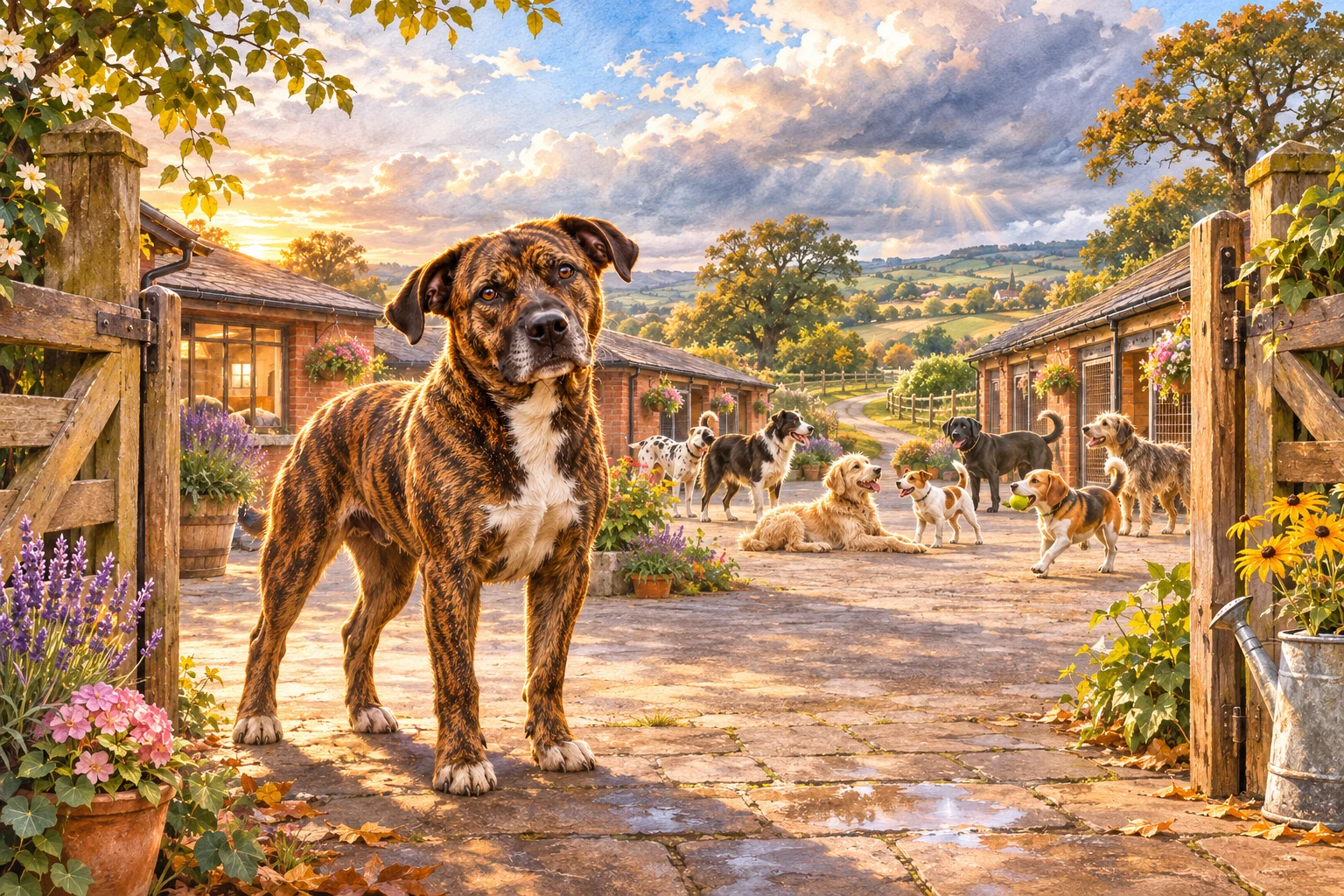
By the first full week of January, the black-and-white dog from Jaspa’s Christmas story had a name.
Rocky had learned it on Boxing Day, when Harry took a council call in the office.
“The older black-and-white male,” Harry had said. “Cloudy eye. Deno?”
Rocky had been under the desk.
The name had landed like a dropped bowl.
Harry wrote a planned transfer date beside DENO on the office board.
That date had already passed.
A date was worrying when it approached. Somehow it was worse after it passed and nothing happened.
The kennels remembered they were kennels again — cold floors, warm breath, and a chorus of dogs who believed time was an invention made to delay breakfast.
Deno was supposed to have moved. He had not. Paperwork. Staffing. Van availability. Human words that all meant the same thing: wait.
Rocky had watched Harry ring the council twice the day before. He could not understand every human word through an office door, but he understood tone.
Harry had used the patient voice — the one that meant he was trying not to become the impatient version of himself.
“Still waiting on sign-off,” Harry had told Ted afterwards. “Andy’s chasing it.”
Waiting. Chasing. Sign-off. More human words that put distance between a dog and a door.
Rocky had gone to sleep with Deno’s name in his head and the old fire under his ribs.
He had tried every trick he normally gave other dogs. Chew something. Sniff something. Move your body. Let the thought pass without following it down the corridor.
The thought had refused to pass.
At two in the morning he had heard Harry cross the flat above, then stop directly over the office as if he too had woken with a problem he could not put down. For a few seconds man and dog had been separated by one floorboard and exactly the same helplessness.
Rocky had almost barked.
He had not. Harry would have come downstairs. Harry always came back. And if Harry came down, Rocky knew he would stay.
That was the trouble with being loved properly. Sometimes it made foolish decisions harder to make.
Christmas still clung to Hearth in tired bits of tinsel and a paper star above the kettle, but Rocky had stopped counting sleeps. He counted phone calls instead.
Harry was up before the lights. He always was. Not because he enjoyed mornings — nobody enjoys mornings in the first week of January — but because the dogs didn’t care what you enjoyed. A dog with a full bladder doesn’t do patience. He does facts.
Up in the small flat above the office, the kettle clicked and hummed like it was arguing with the cold.
Harry padded around in socks, mug in hand, wearing the kind of face that said: I’m awake, but I don’t agree with it. The mug said WORLD’S OKAY-ISH BOSS. He’d bought it himself. Nobody else was that brave.
Below him, Hearth stirred. Doors creaked. A radiator’s sigh travelled down the corridor like an old dog getting up from a nap.
Somewhere, Digger gave an experimental bark — just to see if anyone was listening — and Bruno replied with the tired patience of a dog who’d seen too much excitement and wasn’t buying any of it today.
In the office, Rocky lay on a folded blanket that smelled faintly of disinfectant and yesterday’s biscuits. He didn’t sleep properly anymore.
He tried. He really did. But his thoughts kept circling the same place, the same memory, the same question he couldn’t stop worrying at.
Elsa, tucked near the desk with her paws neatly crossed, watched him with the calm of someone who’d learned that storms don’t get smaller by pretending they aren’t there. Elsa stayed over on Kara-days — the longer vet shifts — because Hearth ran on routine, and routine was easier when the steady ones stayed put.
Rocky’s tail thumped once, then stopped. His ears flicked. His eyes stayed open.
“You’re doing the thing again,” Elsa said. She didn’t raise her voice. She didn’t need to. Rocky could hear disappointment in a whisper.
Rocky’s mouth opened, closed, then opened again, as if he was testing words the way he tested escape routes.
“I can’t… settle,” he admitted.
“I noticed.” Elsa’s tone was dry, but not unkind. “You’ve been polishing the same worry all week. If you keep rubbing it, it’s going to shine right through your brain.”
Rocky gave a small huff that was almost a laugh. Almost.
Outside, the early shift began to arrive: boots on gravel, car doors, a muffled greeting, the sound of keys finding their place.
Ted’s van rolled into the yard with the steady confidence of someone who believed reversing should be dramatic. It wasn’t. Ted just liked the sound the beep made. He said it reminded him the world still worked.
Ted stepped out, stretched, and immediately got barked at by three dogs who were certain he was late, and two who were certain he was early. Ted nodded solemnly, like a judge receiving important evidence.
“Right,” he said to the kennel block, “I can see this is going to be one of those days where I’m wrong before I even say hello.”
Escape Committee training happened whenever Ted decided it happened. The rules were simple: learn, laugh, and do not set anything on fire.
Rocky and Elsa were the glue that made it work - Ted’s ‘staff’, as he liked to call them - not because anyone had written it down, but because in Rescueland every rescue dog had two jobs: survive the past, and practise the future. The pups (and, if we’re honest, the grown-ups) behaved better when Rocky and Elsa behaved like they expected better.
That morning, the ‘committee’ practised the basics again: wait at gates, pause at corners, and look like you belong somewhere even when you’re not sure you do. Ted called it “Confidence Practice.” Elsa called it “Not Getting Run Over.” Rocky called it “Pretending.”
It should have helped. It usually did.
But every time Rocky stopped at a gate, he saw another one in his mind — a gate he couldn’t name, a gate from before Hearth, before the committee, before the calm. A gate that had taken something from him and never given it back.
A lead clip struck the metal gate behind him.
Clink.
Rocky spun before he could stop himself. Teeth flashed. Not at anyone — at memory.
Reg froze halfway through an enthusiastic bounce. Bruno opened one eye.
Elsa did not crowd Rocky. She waited until his breathing came back and then said, very quietly, “That is exactly why going alone is a bad idea.”
Rocky looked at the gate. “And exactly why I need to know.”