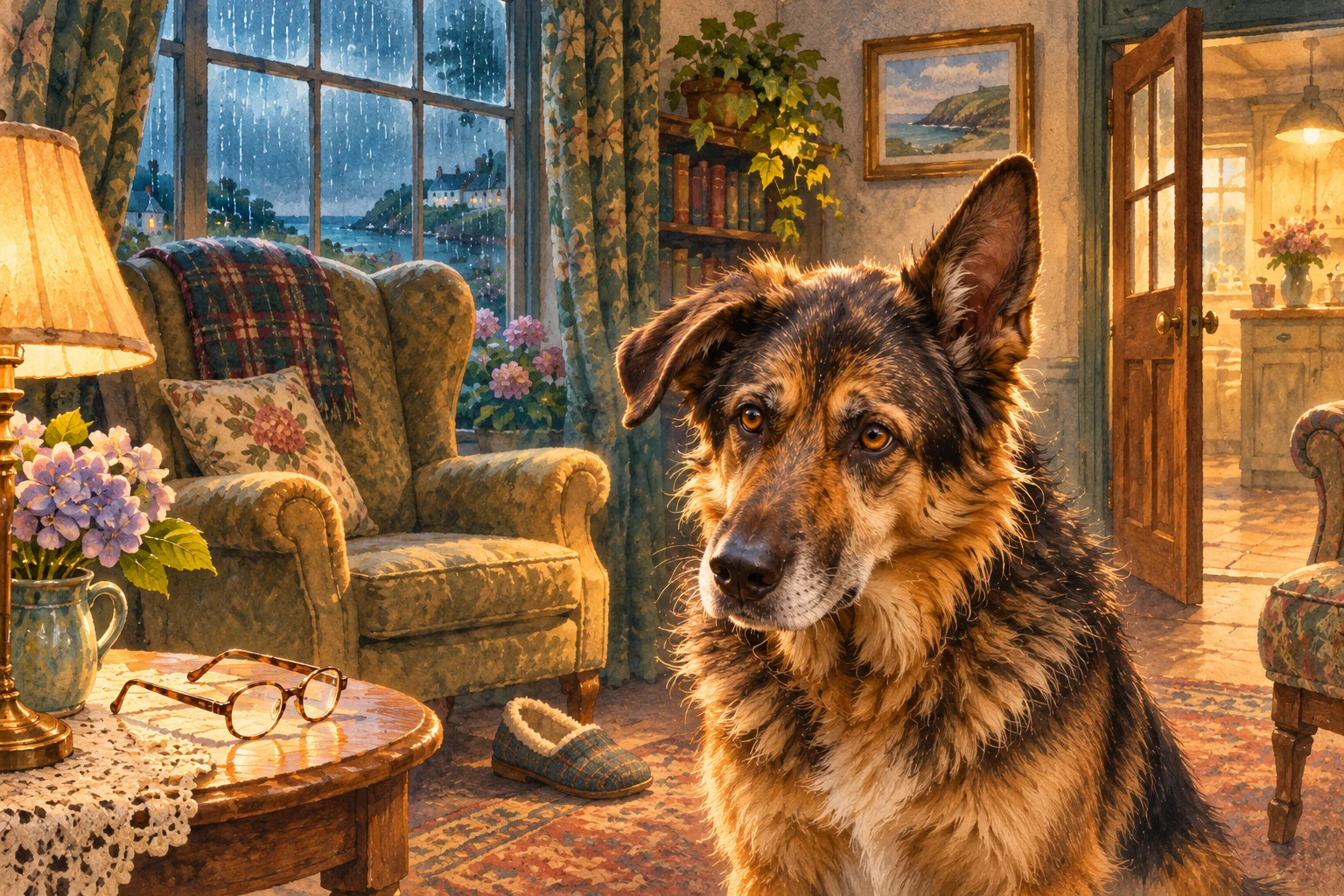
At Rosewood House, things went missing every day.
Spectacles.
Slippers.
False teeth.
Tuesdays.
Most of them had not been stolen.
That was important.
Mrs Barnes once reported a cardigan missing for three days before somebody pointed out that she was wearing it. George lost his glasses twice in the same afternoon. The first time they were on top of his head. The second time they turned up in the refrigerator beside a packet of grated cheese. He could offer no explanation for this. Mr Pritchard regularly reported his pudding missing before pudding had been served. And there had once been a six-month investigation into a television remote control which finally ended when Mandy moved a pot plant. Nobody had put it there. Nobody admitted putting it there. The remote was simply found beneath the leaves, covered in dust and still tuned to BBC One.
Rosewood accepted these things.
Care homes had their own relationship with possessions. Objects travelled. Cardigans migrated. Walking sticks changed ownership. Teaspoons vanished into a dimension from which teaspoons apparently never returned. Usually, if something went missing, somebody called Claire. If Claire could not find it, they tried housekeeping. If housekeeping could not find it, somebody blamed the laundry. And if the laundry denied responsibility, everyone agreed the object would probably turn up when nobody was looking for it. This system was remarkably successful.
Until Edith Mercer's silver locket disappeared.
But that came later.
At seven fifteen that morning, my biggest problem was porridge.
Twenty-seven bowls.
Porridge had a very narrow window between comforting breakfast and industrial adhesive, and I was rapidly approaching the second.
"Come on."
I stirred harder.
The porridge remained uncooperative.
"Don't do this to me."
Behind me, the dishwasher beeped.
"Nor you."
It beeped again.
Our dishwasher was called Doris. This was not a manufacturer's decision. Its actual name involved a collection of letters and numbers printed on a metal plate behind the rinse arm, but Doris seemed more appropriate. Doris was noisy, temperamental and perfectly capable of refusing to work because a teaspoon had offended her. I opened the door. Steam escaped. One plastic beaker lay upside down across the spray arm.
"There. You brought that upon yourself."
"You do realise you're talking to a machine?"
Sophie stood in the kitchen doorway carrying a stack of breakfast trays.
"Machines listen better than people."
Doris beeped.
"Usually."
Sophie smiled.
She had been at Rosewood for about three weeks. Early twenties, perhaps. Kitchen assistant some days, general support on others, depending on who had rung in sick and which agency shift had failed to arrive. Care homes ran partly on rotas and partly on people saying, "Go on then, I'll cover it." Sophie tied her hair back more tightly than necessary and moved quickly through rooms without making much noise.
I had noticed that.
Not because there was anything wrong with moving quietly. Because before I became a chef, I had spent years working with dogs. Rescue. Behaviour. Rehabilitation. Dogs carrying histories nobody had written down because nobody had thought to ask. You learned to notice things.
Not conclusions.
Things.
A change in breathing. Weight shifting backwards. A mouth closing. Eyes moving towards a door. A person entering a room as though they belonged there. A person entering the same room as though they would rather nobody remembered seeing them.
Observation was not magic.
It did not tell you guilt. It told you where the questions were. Kitchens taught much the same lesson. Who came in. Who went out. What time the milk arrived. Which fridge had been opened. Which resident suddenly stopped eating something they normally liked. Which tray went upstairs and which came back. People imagined chefs thought mainly about food. Mostly we thought about sequence. Breakfast had to happen before lunch. Vegetables before service. Gravy after the meat but before twenty-seven people decided they wanted it at once. One thing moving out of place changed everything downstream. I spooned the final porridge into a bowl.
"Twenty-seven."
"Twenty-six," Sophie said.
I stopped.
"Why?"
"Mrs Cartwright went to hospital last night."
Right.
I removed one bowl.
"Twenty-six."
That was Rosewood.
Everything could change between peeling potatoes and putting them on a plate. Ludvig appeared at the kitchen doorway at seven forty-three.
He never crossed it.
Not one paw.
Dogs were not allowed inside a working kitchen, and Ludvig understood the invisible boundary better than several members of staff. He stood behind it and stared at the tray of sausages with the gravity of a customs officer examining contraband. Ludvig did not look like a therapy dog. He looked like a dog who might require one. Large. Staffordshire Bull Terrier crossed with German Shepherd, although I suspected several other breeds had made contributions without leaving paperwork. The Staffie had given him the broad head, powerful chest and determination. The Shepherd had supplied his length, huge feet, intelligence and one magnificent upright ear.
The other folded halfway over. They had never reached an agreement. His muzzle was greying. Some from age. Some, I thought, from living too much life before he ever arrived with me. He had been found thin and frightened. Raised hands bothered him. Sudden bangs. Men approaching too directly. Plastic bags blowing across pavements appeared to represent some unspeakable threat. Traffic cones were unacceptable. Umbrellas required careful assessment. Yet put Ludvig beside somebody who was crying and he became something else. He did not climb on them. Did not paw. Did not demand affection.
He simply stayed.
Close enough to be available. Far enough away to allow choice. That was how the dog who had once needed therapy more than most had eventually become a therapy dog himself. Life had a sense of humour. Ludvig looked at the sausages.
"No."
His upright ear moved.
"You've eaten."
Tail against wall.
Thump.
"Waste not, want not does not apply to somebody else's breakfast."
Sophie laughed.
"My gran says that."
"Waste not, want not?"
"She keeps wrapping paper."
"So does Mrs Barnes."
"My gran irons hers."
I looked at her.
"Mrs Barnes irons hers too."
Sophie grinned.
Perhaps every family eventually became Rosewood House.